Tuesday, 30 July 2013

The Return of the Grocery Van

As many of you may know, I’m a great advocate of multi-channel shopping solutions.  In my mind we will (indeed many of us already have) found that purchases across the different shopping categories will be divided across all the current channels (Supermarkets, Convenience, Discounters & Online – both standard and non-standard retailers) in a way that relates to the characteristic of each category to the shopper.

Let me lay down some examples;

 Products                                              Typical Frequency               Ideal Channel

Milk & Bread                                       Daily                                      Convenience
Health & Beauty                                 Monthly                                Supermarket (or indeed High Street)
Biscuits & Cereals                               Bi-weekly (Light)                 Discounters
Soft Drinks & Tinned                          Bi-weekly (Heavy)               Online Grocers
Washing Powder & Toilet Roll         Quarterly (Volume)             Online Non-Grocers (Amazon)

Of course these are meant to demonstrate indicative differences, and any can be bought from any channel, but you may take my point that shopping across the channels is so much more convenient, depending upon the category.  Indeed overall convenience in all its guises is very much in the minds of the shopper nowadays, and they are willing to pay a premium (sometimes small but a premium all the same) for this convenience.

There is of course one important category that I have not mentioned (indeed there are a few, but I want to focus on one in particular!), and that is Fresh Fruit & Vegetables, where does that fit?

Well it is more akin in frequency of Milk and Bread, but the selection in the convenience channel is generally poor, discounters are improving their offering in this regard but that is not convenient for most, and doing smaller top-ups in the supermarket channel can be time consuming.  Further, the online channel can never perform well in this category as shoppers mistrust of a third party selecting the best produce is a key barrier…so what about the humble grocery van?


This isn’t as daft as it sounds…think about it, it has lots of advantages that other channels don’t.

It’s the ultimate in Convenience as the van comes to you.

Shoppers can ensure Quality by handling and selecting their own produce.

It’s Green as is stops those short car journeys to the nearest store.

It promotes Healthy eating by making fresh produce even more accessible.

It therefore completes the full repertoire of shopper requirements amongst the available channels moving forward!  Who would have said 10 years ago that their main store was the local petrol station!

Things have changed, and will continue to change as shoppers move away from the large weekly shop to a more demand based model, where they know the consumption occasions of all their purchases.  Additionally where there is constant demand for certain products or brands on an on-going consumption basis, stocking up via online retailers (whether specialist or non-specialist grocers) will continue to grow.

…so I’m just off to my local van dealership to get mine kitted out, are you?


Thursday, 4 July 2013

Is “The Apprentice” damaging the research industry?


The current series of The Apprentice has poignantly illustrated the distorted and potentially damaging representation of market research currently being broadcast to the public on a weekly basis.

Don’t get us wrong we are big fans of The Apprentice here at Evolution, but when we take our telly hats off and put our research caps on, we feel we have to fight our corner a bit because The Apprentice doesn’t always portray our industry in the best light.

The thing about The Apprentice is that, for the benefit of entertainment, it necessarily shoe-horns projects that, in the real world would take months to complete into a two day mad scramble. The results are not so much half-baked but more a doughy mess.

So in this context it’s inevitable that a research project that would in reality involve a range of methodologies conducted over multiple stages is reduced to a ‘research bit’ consisting of a single “let’s ask 5 people” focus group and base an entire idea around it.. How often would we as research professionals recommend just one focus group…?

Then there’s the Cardinal Sin that these groups are moderated by the candidates themselves, who obviously have something of a vested interest in seeing their ideas come to fruition.

Of course, it’s all part of the fun that these supposedly brilliant business minds are rarely more than egotistical wannabes, but it’s unfortunate that their collective perspective on research is that it’s a hurdle over which their ideas need to leap, rather than a tool that can help to develop and hone concepts.

In truth, it’s pleasing that research is recognised on such a high profile show. And really it’s quite satisfying that the results of poorly conducted research are laid bare for all to see.

Tuesday, 2 July 2013

Predicting the Future of Grocery Retailing

As the leading research agency into the attitude and behaviours of shoppers in the grocery sector, and following a large number of projects undertaken relating to channels (both in the UK and Europe) I felt it was time to use this knowledge to try and predict the future.

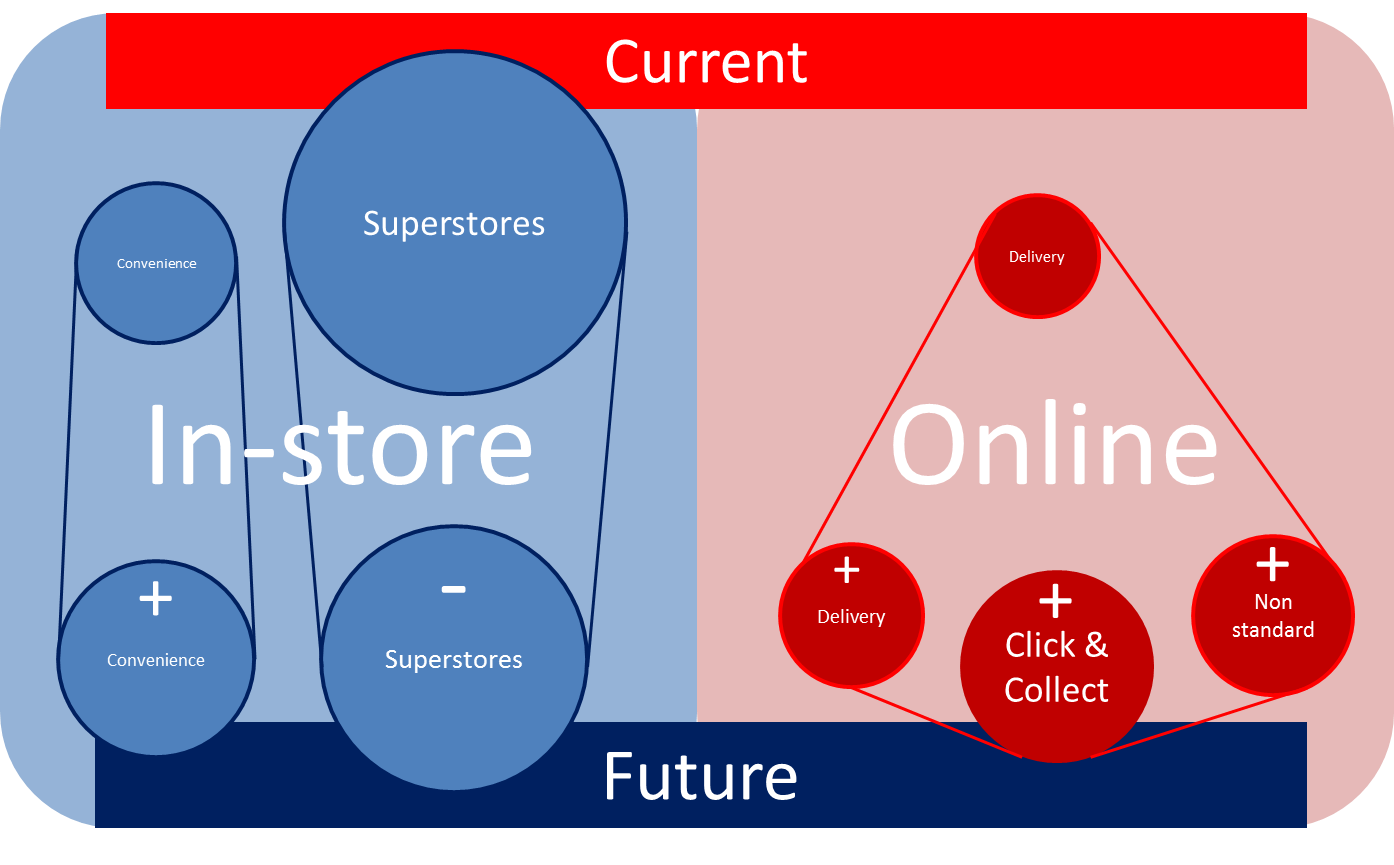
In this brief overview, I will attempt to demonstrate why it is so important to invest research into channels outside that of the superstore, where, let’s be honest, we know quite a lot!!  For simplicity, I am considering discounters by their store type rather than their business models.


Superstores are more and more being seen by shoppers as the channel to avoid if at all possible “Can I manage without ever going in one?”….”Who wants to trail round a superstore in their leisure time?”….”I dread the experience”….”We pile our trolley high with things we probably won’t even eat”….people love eating, but don’t particular like shopping.  How different this is from our French neighbours whose mission is to find the best quality food, in the UK it is so much more functional than that. So, what are the alternatives?

The rise of the convenience sector, driven by the increasing store estates of the multiples have given shoppers the wider choice to buy just what they need, when they need it.  This all from retailers they know and trust (most of the time!), where the biggest brands are still available at reasonable prices (although they also recognise they are paying for the privilege, they seem happy to do so).  And convenience really is the key as they combine their commutes with manageable quantities of product, where the consumption occasion is already known…”Maybe I spend a bit more, but I know that it’ll all get eaten with no waste”.

Online continues to grow at above 20% per year, but from a low base, this is still pretty small in the whole scheme of things, but our research suggests we are nearing the tipping point for even faster expansion in this channel.   The introduction of click & collect in the way they have in France (where one can order at work in the afternoon, and two hours later drive to a designated car park – dark store or store car park - and have their goods loaded into their Renaults), will revolutionise the online channel beyond recognition.  No longer will waiting at home for a two hour slot be seen as convenient, and if they forget to order something, they can still nip into the store to augment their online order at the same time.

I also predict a dramatic rise in shoppers using non-standard grocery channels such as Amazon, where they benefit from big discounts on non-perishable produce, and larger SKU’s which they don’t mind storing if the price is right.  Manufacturers will ignore this at their cost, with the opportunity to sell SKU’s that superstores will not stock, there should be no issues.  I believe shoppers will change their mind-sets on where to buy certain products, fresh is one thing…but boxes of their favourite brands is another, and anyway they already have an account!

So in summary, the market will demand less supermarkets, continuing growth in the convenience sector, whilst online will establish itself as the key channel for larger shopping missions with a shift to more click & collect methodology and the growth of non-standard grocery channels (like Amazon).


Tuesday, 14 May 2013

Morrisons and Ocado

I have got to say that I am struggling to get my head around the Ocado/Morrisons tie up.

So what are the possible options (well at least the ones I can think of!)?

Option 1 - Ocado deliver for Morrisons – Instantly gives national logistical coverage, and Morrisons trade on the good reputation of Ocado’s service standards.
Option 2 – Morrisons use Ocado hubs and employs their own drivers – again instant coverage, without leveraging Ocado’s reputation.

Option 3 – Morrisons plugs into Ocado’s technology – using an existing platform that works could prevent teething problems.
Option 4 – A combination of the above.

The first thing that is causing me confusion is the livery on the vans themselves if any part of option 1 is used, are they going to say Ocado? If so why would Morrisons want to have a competitor’s van delivering their produce and causing confusion (and indeed add marketing value for Ocado) for the shopper?
Now of course I can understand that the cost saving (Capex) of using an existing fleet - even if that fleet would need a large expansion in numbers to cope with the predicted volume increase.  But for me, it seems like Morrisons are surely just kicking the ball down the road on this one (unless of course they opt for option 2).  Now I am sure if asked they would say that their core competence is supply chain not home deliveries, so therefore aren’t they already pretty knowledgeable in logistics?  It seems to me they are trying to enter the market on the cheap, and although we know that Morrisons have said that they only enter the online market if it was profitable almost immediately…is this really the right option?

Now don’t get me wrong, I have never thought that Morrisons should rush to enter the online market just because their competitors do it! Unlike almost every other commentator! Market Share isn’t everything…turnover for vanity, profit for sanity.   I agree that any business unit (or channel in this case) should be profitable by itself, but they have taken an awful long time to come to a decision, which in reality doesn’t appear to be much of a commitment to online (I have been critical of how slow they have been to embrace the convenience channel, but more of that for another day!!).
There is also the problem with Waitrose (or Waitrose having a problem with the tie-up to be precise), and how close to breaching the Waitrose/ Ocado agreement does this come, if not in law, in principle.  This can only end badly for some or all the players.

I am a great advocate to organic growth in business, rather than trying to run too early.  Morrisons have done some trialling on fresh in the Greater London area (Fresh being a poor penetration category online currently this seems sensible), but there is a significant difference between that and a full SKU level model nationwide. 
For me I think I would have been more tempted to concentrate on trialling to my shopper heartland (for us up’t north!) on a selected area basis.  These shoppers may be more forgiving early on, and accept that there may be the odd hiccup along the way…..but of course option 3 should prevent any of these issues…..I wait with baited breath!

Craig Bradley

Monday, 22 April 2013

The Rise and Rise of Online Grocery Shopping

Our monthly shopper survey monitors the purchasing behaviour of various retail categories online during the previous month made by a household’s primary food and grocery shopper.

March saw the most dramatic rise in online shopping behaviour since we started collecting data, and with an amazing 34% of shoppers buying some food & grocery items online, demonstrates just how fast the market is changing.  Now of course, we have seen that the high street foot fall had been effected considerably by the recent snow, but is that really the only reason? And notwithstanding that, will shoppers change their habits to embrace online more in the future?.....or is it just a blip? I think not!

Three categories saw a distinct rise in online activity during March (Cosmetics, Clothing/Shoes and Food & Grocery), with food & grocery seeing the greatest percentage increase at 21% (28 to 34% penetration).  Yes, I know that online sales only make up around 5% of total spend, but we could soon be getting to a tipping point where previously estimated growth could be woefully low!

This will no doubt be cause for some head scratching within the effected retailers, with their estates of larger format supermarkets, are they really fulfilling the current needs of shoppers for flexibility and convenience? 
Of course ‘Click & Collect’ is definitely part of the solution moving forward, as seen, for example, in the French market (although a less mature online market overall), where over 50% items are ordered online, and then collected from the store car park (or dark store)!  This allows shoppers to be more in control when it comes to timings, as well as only needing to order 2 hours in advance.  So imagine ordering during the afternoon at work, and picking up on your way home.

The effect of this rise in online shoppers within the food & grocery sector isn’t quite as straight forward, as the same retailers are getting the sales one way or another (in-store & online). We are also seeing the rise of shoppers using non-standard channel such as Amazon to fulfil their needs across a wide range of categories.  The advantages to shoppers are obvious, no minimum orders, lower or no delivery charges, different SKUs available, not to mention the ease of order other categories at the same time as the penetration of accounts is generally higher than the standard retailers.

It really is time for both retailers and FMCGs to grasp the opportunity that online has to offer, as we have seen recently from the client work we carry out in this area, there’s lots of work to do, and small improvements can yield great results!

Craig Bradley

Monday, 15 April 2013

The Best Food & Grocery Retailer Award!


We have recently undertaken the largest study into shoppers’ attitudes about the largest food & grocery retailers in the UK, and having seen many different rankings recently, we felt we were in a great position to offer our take on which retailers are doing what shoppers really want!

By understanding what a shopper requires from a shop across 4 key criteria (Price, Quality, Value & Range), and then crossing this with what shoppers felt that the supermarkets they use regularly do the best…and then adding a qualitative comments index from our the sample of 5000 primary household shoppers (in relation to Price, Range, Service, Value, Store, Stock & Quality), we were able to give a fully rounded view to who shoppers felt was the best all-around store.

And the overall winner was….Waitrose!

Rank
Supermarket
Quantitative index
Qualitative index
Overall Rating
1
Waitrose
94
133
227
2
Morrisons
104
121
225
3
Aldi
106
108
214
4
Lidl
104
108
212
5
Marks and Spencer
92
118
209
6
Asda
110
94
204
7
Sainsbury’s
99
102
201
8
Tesco
102
75
177
9
Iceland
102
75
177
10
Co-op
87
67
154

Although Waitrose were only ranked 8th when it came to the quantitative index, they achieved far and away the greatest qualitative score based on comments by their shoppers, so although they didn’t rank well on Price or Value, shoppers loved the overall experienced (plus Quality & Range) which more than made up for this. This further demonstrates that price may be important to some, but the whole store experience should not be ignored.

Morrisons’ second placed ranking was also bolstered by a high qualitative score and a satisfactory quantitative ranking, whilst two discounters (Aldi & Lidl) performed well on both metrics. Asda were the top supermarket when only taking into consideration their quantitative score as shoppers felt their proposition best matched their expectations, but were slightly let down by some in-store issues on their qualitative index.
Sainsbury’s was close behind Asda, but the news is not so good for Tesco, whose shoppers had some serious issues with the brand and store, and only just headed Iceland. The Co-operative appears to be failing to win the hearts and minds of their shoppers, ranking bottom on both indexes.

For more detailed analysis on all the retailers mentioned, please see our Retailer Series of reports which are launched this week.


Craig Bradley


Monday, 18 March 2013

Omni-Channel; the Future


The demise (predicted by many) of the Bricks & Mortar retailer may be premature even if there is a rise (seen in our latest research) in showrooming across lots of categories.  And although the art of showrooming takes hold for many looking for online bargains and convenience, they often still require the re-assurance of seeing the real thing!

With nearly a third of shoppers already admitting to showrooming, it is vital that retailers react positively to ensure it is a competitive advantage to embrace the concept.  Price is the key driver to online shopping, and the high street must accept that the cost of carrying stock on the high street where rents are high is a big competitive issue against online retailers.  Beyond price though, the need for a shopper to actually see and touch the product ensures that there is still a place in retail for ‘real’ stores.  We have already seen shops in the US popping up where no product can be taken away from store, but merely viewed and then ordered for home delivery.

Food retailers have an opportunity to develop propositions around what we call ‘Now & Later’, where shoppers do their shop in-store, selecting which items they take with them, and scanning those they wish to be delivered later.  This negates the perceived issues with fresh amongst irregular online shoppers, and introduces those that enjoy the in-store experience to the convenience of home delivery and increased basket sizes.

It is virtually impossible for a shopper to be able to survive effectively without visiting a store at some time or another, indeed in our last online report only 0.4% of primary shoppers say they never visit a store in person.  The potential rise of ‘Click and Collect’ and something similar to our ‘Now & Later’ proposition make stores fully relevant moving forward and not necessarily the ‘Ball & Chain’ that many feel large store estates will become.  Throw into the mix a good spread of Virtual Reality where space is an issue, and I think we are seeing what the future may hold!

See our latest report on Showrooming here.